Starlink: internet from space at 30 francs per month
Let me tell you about a scene I have experienced many times. A client calls me from his cottage in a Ticino valley. He wants internet. He has tried 4G/5G: but......
...only one bar, on a good day. He asked Swisscom: fiber doesn't reach him.
He tried with a repeater: nothing doing. “Luca, is it really possible that in 2026 I still can't send an email from my house?”
Until yesterday, the answer was: even in our dear Switzerland, yes, it’s possible. Starting today, that answer has changed. It’s called Starlink.
Starlink is the satellite internet service from SpaceX, Elon Musk’s aerospace company. It works in Switzerland. I have been personally testing it for several weeks. And I’ll tell you right away the thing you care about most: the basic plan costs 30 francs per month. The compact antenna, the Mini model, comes with a free loan for use. You don't pay for the hardware. You pay for the subscription and you surf. For those who live or work in areas where internet is slow, unstable, or nonexistent, this is concrete news. Alpine valleys, grotti, rustic cottages, farms, construction sites in the middle of nowhere. Places where Swisscom, Sunrise, and Salt don't reach with fiber and where the mobile signal struggles to pass through the mountains. Starlink solves the problem because it doesn't use cables, it doesn't use terrestrial towers, and it doesn't depend on mobile coverage. It uses satellites.
Let me explain how it works, because it’s simpler than you might think. In Earth's orbit, at an altitude of about 550 kilometers, thousands of small satellites are circling. The Starlink antenna you place on your roof, balcony, or in the garden connects to these satellites and receives internet. The antenna orients itself. It automatically aligns with the satellites passing overhead. You don't have to point it, you don't have to adjust it. You plug it into the power, wait a few minutes, and you're online.
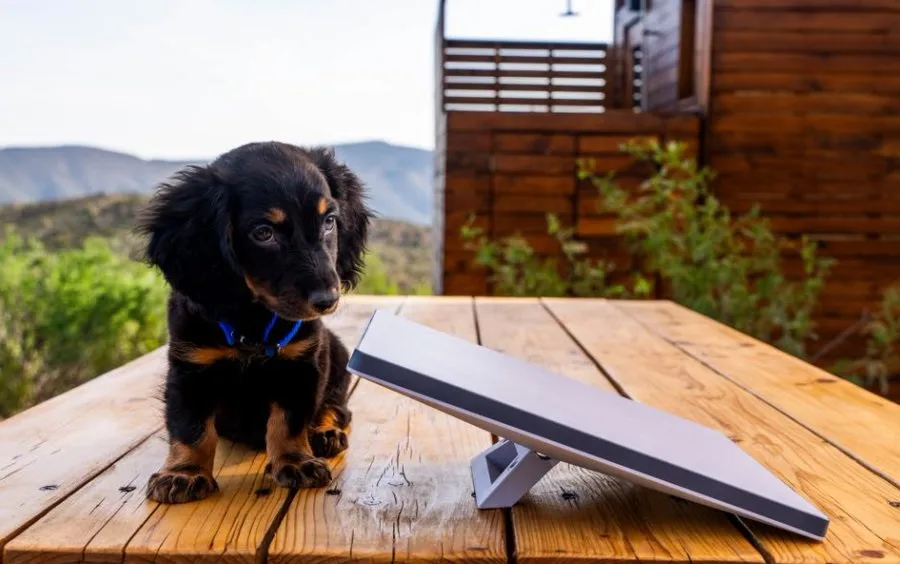
The Mini antenna, the one that comes with the 30-franc plan, is compact. I take it with me when I move around. It fits in a backpack. I set it on an outdoor table, connect it to my phone, and in five minutes I have high-speed internet where before there was nothing. For those who work on the move, for those with a camper, or for those hosting outdoor events, it’s a solution that didn't exist before.
The speed of the basic plan ranges from 45 to 130 megabits per second in download. It’s not the 1,000-megabit fiber optic you have in Lugano. But it’s more than enough for browsing, video calls, watching streaming movies, and working remotely. For those who currently have a 5 or 10-megabit DSL connection in a rural area, the jump is enormous.
A point to know: latency. It’s the time that passes between when you click on a link and when the page starts to load. With fiber, you're around 5-10 milliseconds. With Starlink, you're between 20 and 40. For daily browsing, video calls, and streaming, you won't notice the difference. If you play online video games at a competitive level, it might bother you. For everything else, it works.
You handle the installation yourself. You download the Starlink app on your phone. The app uses the camera to check if the sky above the antenna is clear of obstacles. Trees, roofs, chimneys: everything that blocks the view of the sky reduces signal quality. The ideal position is an open spot, a flat roof, or a north-facing balcony. The antenna has integrated heating that melts snow in winter. An important detail for those living in the mountains.
A practical aspect that many don't know: with Starlink, you don't need a long-term contract on the standard plan. If you leave for three months, you suspend the subscription. When you return, you reactivate it. No penalties, no complications. For those with a holiday home in a valley where internet doesn't reach, this flexibility is precious.
I must also be honest about the limitations. In the city, Starlink doesn't make much sense. If you have fiber or good 5G, you are better served and often at a similar or lower price. Swiss providers offer high speeds for about 50 francs per month. Starlink doesn't compete with those speeds. It competes with nothingness. And where there is nothingness, it wins.
Another limit: the antenna consumes more energy than a traditional router. In a rustic cottage powered by solar panels, this must be considered. Consumption is around 30-50 watts during normal operation, but it rises with the heating active in winter.
Three tips for those who want to try it. First: go to starlink.com and enter your address. The site tells you immediately if the area is covered and which plan is available. Second: download the Starlink app before ordering. Use it to verify that the spot where you want to place the antenna has a clear view of the sky. Third: if you live in a rental, ask the owner for written permission before installing the antenna on the roof.
Thirty years ago, internet arrived with the screeching sound of a 56-kilobit modem. Those living in the countryside waited minutes for a page to load. Then came ADSL, then fiber, then 4G. But each time, the valleys and remote areas were left behind. Starlink changes this story. For the first time, internet arrives wherever the sky reaches. And the sky, fortunately, reaches everywhere. Even in Val Bavona